Guthrie suspect's mask, clothing believed to be from Walmart, sheriff says

Sheriff Chris Nanos of Pima County, Arizona, tells CBS News that investigators searching forNancy Guthriebelieve the clothing and face mask worn by the suspect in thechilling doorbell video released last weekwere purchased at Walmart.

They are still working to identify each brand. CBS Newsfirst reportedthat the suspect's backpack, identified as a black Ozark Trail Hiker, was sold exclusively at Walmart.

It remains unclear whether the items were bought online or in-store in Arizona or elsewhere. The sheriff said investigators have spent several days reviewing surveillance video at local Walmarts.

Two of the images released by the FBI of a subject seen on surveillance video in the Nancy Guthrie case. / Credit: FBI

Guthrie, 84, the mother of "Today" show co-hostSavannah Guthrie, has been missing since Feb. 1. Authorities believe she wasabductedfrom her home in Tucson in the middle of the night.

Nanos called the backpack "one of the most promising leads" in the case.

Walmart has provided records of all Ozark Trail Hiker online and in-store purchases over the past several months, including sales beyond the Tucson area, to investigators, Nanos told CBS News.

The FBI says the masked figure seen on Nancy Guthrie's Nest doorbell camera was carrying a black 25-liter Ozark Trail Hiker Pack backpack like the one seen at right. / Credit: FBI

CBS News has reached out to Walmart corporate offices but a spokesperson declined to comment.

Investigators believe the face mask the suspect wore is black but appears lighter on the video footage due to Nest camera's infrared technology.

DNA evidence on glove

Meanwhile, authorities areconducting DNA testingon a blackglovefound near Guthrie's home which "appears to match the gloves of the subject in the surveillance video," the FBI said in a statement on Sunday.

The FBI said it received preliminary results of DNA testing on Saturday, and once those findings were confirmed it would enter what it called "the unknown male profile" into CoDIS, the FBI's national database for matching DNA profiles, which contains data on people with previous arrest records.

The bureau previously described the individual as a male with an average build who is about 5 feet, 9 inches to 5 feet, 10 inches tall.

Investigators have alsocollected other DNA evidencefrom Nancy Guthrie's property as part of the ongoing investigation, but the results have not led to a suspect, according to Nanos.

Multiple law enforcement agencies spent hoursFriday eveningsearching a residence less than two miles from Nancy Guthrie's home.

Nanos told CBS affiliate KOLD that the activity was the result of following up on "a lead that led to a search warrant and no arrest." Authorities did not release other details on what led them there or what, if anything, may have been found.

On Sunday,Savannah Guthrie postedan emotional video pleading once again for her mother's return.

"It's been two weeks since our mom was taken, and I just wanted to come on and say we still have hope, and we still believe," she said in the video posted toInstagram. "And I wanted to say to whoever has her, or knows where she is ... it is never too late to do the right thing. "

Investigators reviewing retail sales records for clues in Nancy Guthrie case

Investigators chase critical leads as Nancy Guthrie search enters third week

Tom Homan says "I don't like the masks" on ICE agents, but they "have to protect themselves"

Guthrie suspect's mask, clothing believed to be from Walmart, sheriff says

Sheriff Chris Nanos of Pima County, Arizona, tells CBS News that investigators searching forNancy Guthriebelieve the...
Dee Snider Says He's 'Not Dying' After Resigning from Twisted Sister for Health Reasons

House of Hair with Dee Snider/Facebook

People Dee Snider in February 2026 House of Hair with Dee Snider/Facebook

NEED TO KNOW

  • Dee Snider wants fans to know that he's "not dying" amid his struggles with arthritis and heart issues

  • The Twisted Sister lead singer took to his House of Hair radio show to dispel rumors that he is near death following the cancellation of the band's 50th anniversary tour

  • Snider will continue to host his radio show and work on other projects, but tells fans they won't "see me on the stage kicking ass like I used to, because that will mess me up"

Dee Snideris setting the record straight about his health.

The Twisted Sister lead singer took to hisHouse of Hairradio show to dispel rumors about the severity of his health issues following the cancelation of the band's 50th anniversary tour.

"I'm not dying! No, not never. I mean, we're all dying, but not immediately," said Snider, 70, who is dealing with arthritis and unspecified heart issues,in a Facebook clipshared on Saturday, Feb. 14.

He continued, "My announcement about canceling the tour for health reasons, problems with my heart, arthritis, things like that... the rumors have run wild that I'm on my death bed, I am not. I just can't do those things that I did in my 20s, 30s, 40s, 50s and even 60s. Otherwise I'm alive and well. I'm enjoying life."

Eddie Ojeda, Jay Jay French, Dee Snider, and Mark Mendoza of Twisted Sister perform in 2023 in Agoura Hills, Calif. Elyse Jankowski/Getty

Elyse Jankowski/Getty

Twisted Sister officiallycanceled their previously planned 50th anniversary touron Feb. 5, which was set to feature three of the band's longest-serving members: Snider, founding guitarist Jay Jay French, and longtime guitarist Eddie Ojeda. The run would have been their first since their 2016 40th anniversary tour, Forty and F— It.

"Due to the sudden and unexpected resignation of Twisted Sister's lead singer Dee Snider brought on by a series of health challenges, the band has been forced to cancel all shows scheduled," The band said in a statement. "A lifetime of legendarily aggressive performing has taken its toll on Dee Snider's body and soul. Adding insult to injury, Dee has recently found out the level of intensity he has dedicated to his life's work has taken its toll on his heart as well. He can no longer push the boundaries of rock 'n' roll fury like he has done for decades."

Advertisement

Twisted Sister in 1982. Michael Putland/Getty 

Michael Putland/Getty

In the Feb. 14 clip, Snider says he'll remain active and continue to host his radio show, and is even directing a film, but you won't catch him on stage.

"The truth of the matter is, I don't want you to see me up there being less than you expect me to be," he said. "You won't see me on the stage kicking ass like I used to, because that will mess me up,"

Never miss a story — sign up for PEOPLE'sfree daily newsletterto stay up-to-date on the best of what PEOPLE has to offer​​, from celebrity news to compelling human interest stories.

The rocker even threw some playful shade at country legendWillie Nelson, who continues to perform into his 90s.

"You got memories of the great shows that I did, that's what I want to leave you with," said Snider. "Not me standing up there like Willie Nelson. Nothing wrong with Willie, 95 years old, in a wheelchair. I went out rockin', I'm still rockin' here, I ain't stopping. I got a lot of life to live. My dad is 95 and still kicking, so I'm expecting to be around for a long time."

Read the original article onPeople

Dee Snider Says He’s 'Not Dying' After Resigning from Twisted Sister for Health Reasons

House of Hair with Dee Snider/Facebook NEED TO KNOW Dee Snider wants fans to know that he's "not d...
Oscar-winning filmmaker Frederick Wiseman dies, leaving legacy of American institutions

NEW YORK (AP) —Frederick Wiseman, the celebrated director of "Titicut Follies" and dozens of other documentaries whose in-depth, unadorned movies comprised a unique and revelatory history of American institutions, died Monday at age 96.

The death was announced in a joint statement from his family and from his production company, Zipporah Films. Additional details were not immediately available.

"He will be deeply missed by his family, friends, colleagues, and the countless filmmakers and audiences around the world whose lives and perspectives were shaped by his unique vision," the statement reads in part.

Among the world's most admired and influential filmmakers, Wiseman won an honorary Academy Award in 2016 and completed more than 35 documentaries, some several hours long. With subjects ranging from a suburban high school to a horse race track, his work aired on public television, screened at retrospectives, was spotlighted in festivals and praised by critics and fellow directors. Wiseman was in his mid-30s before he made his first full-length movie, but was soon ranked with — and sometimes above — such celebrated peers asD.A. PennebakerandRobert Drewfor helping to establish the modern documentary as a vital and surprising art form.

Starting with "High School" and the scandalous "Titicut Follies," he patented a seamless, affecting style, using a crew so tiny that Wiseman served as his own sound engineer. The results led to acclaim, amusement, head-shaking, finger-pointing and — with "Titicut Follies" — prolonged legal action.

"I don't set out to be confrontational, but I think sometimes the content of the movie runs against people's expectations and fantasies about the subject matter," Wiseman told Gawker in 2013.

Wiseman's vision was to make "as many films as possible about different aspects of American life," and he often gave his documentaries self-explanatory titles: "Hospital," "Public Housing," "Basic Training," "Boxing Gym." But he also dramatized how people functioned within those settings: an elderly welfare applicant begging for assistance, a military trainee complaining of harassment, a doctor trying to coax coherent answers out of a dazed heroin addict, sales clerks at Neiman Marcus rehearsing their smiles.

"The institution is also just an excuse to observe human behavior in somewhat defined conditions,"Wiseman told The Associated Press in 2020."The films are as much about that as they are about institutions."

The bitter and the sweet

For "Titicut Follies," which premiered in 1967, Wiseman visited the Massachusetts-based Bridgewater State Hospital for the criminally insane. He amassed footage of nude men being baited by sadistic guards and one inmate being force-fed as he lies on a table, liquid pouring down a rubber hose shoved into his nose. The images were so appalling and embarrassing that state officials successfully restricted its release, giving the film exalted status among those determined to see it.

In "High School," released in 1968, Wiseman recorded daily life in a suburban Philadelphia school. He filmed a student being questioned about whether he has permission to make a phone call, an English teacher earnestly analyzing the lyrics of Simon & Garfunkel's "The Dangling Conversation," an awkward sex education class in which boys are told the more active they are, the more insecure they must be.

"What we see in Fred Wiseman's documentary ... is so familiar and so extraordinarily evocative that a feeling of empathy with the students floods over us," The New Yorker's Pauline Kael wrote. "Wiseman extends our understanding of our common life the way novelists used to."

Wiseman made movies without narration, prerecorded soundtracks and title cards. But he disputed, forcefully, that he was part of the "cinema verite" movement of the 1960s and '70s, calling it a "pompous French term that has absolutely no meaning."

Oscar winnerErrol Morrisdubbed him "the undisputed king of misanthropic cinema," but Wiseman insisted that he was not a muckraker out to correct injustice. He saw himself as a subjective, but fair-minded and engaged observer who discovered through the work itself how he felt about a given project, combing through hundreds of hours of footage and unearthing a story — sometimes despairing, sometimes hopeful. For "High School II," he visited a school in East Harlem in the 1990s, and was impressed by the commitment of the teachers and administrators.

"I think it's as important to document kindness, civility and generosity of spirit as it is to show cruelty, banality and indifference," Wiseman said when he accepted his honorary Oscar.

He was as adventurous in his 80s and 90s as he was in his 30s, making "Crazy Horse" about the erotic Parisian dance revue, the 4-hour "At Berkeley," about the California state university, and the 2 1-2 hour "Monrovia, Indiana" about an aging rural community. Wiseman also had a long career in theater, staging plays by Samuel Beckett and William Luce among others and adapting his movie "Welfare" into an opera. In 2025, he had brief acting roles in two acclaimed movies — as a poet in"Jane Austen Wrecked My Life"and off-screen as a radio announcer in"Eephus."

Much of his own work was made through Zipporah, named for his wife, who died in 2021. They had two children.

The poetry of life

Wiseman was born in Boston, his father a prominent attorney, his mother an administrator at a children's psychiatric ward and a would-be actor who entertained her son with stories and imitations. His education was elite despite attending schools with Jewish quotas — Williams College and Yale Law School — and his real life experiences were invaluable for the movies he would end up making.

In the 1950s and early '60s, he worked in the Massachusetts attorney general's office, was a court reporter in Fort Benning, Georgia; and Philadelphia, a research associate at Brandeis University and a lecturer at Boston Law School. Drafted into the Army in 1955 and stationed in Paris, he picked up some practical film knowledge by shooting street scenes with a Super 8 camera.

"I reached the witching age of 30 and figured I better do something I liked,"Wiseman told the AP in 2016."It was just a few years after the technological developments that it made it possible to shoot synchronous sound ... so that opened up the world for filmmaking. And there were so many good subjects that hadn't been filmed, as there still are."

His new career began with narrative drama. He read William Miller's "The Cool World," a novel about young Blacks on the streets of Harlem, called up the author and acquired rights. Wiseman served as producer of the low-budget, 1964 adaptation that was directed by Shirley Clarke, and he became confident that he could handle a movie himself.

While teaching at Boston Law School, Wiseman organized class trips to the nearby Bridgewater facility. In 1965, he wrote to officials there, proposing a film — ultimately "Titicut Follies" — that would give the "audience factual material about a state prison but will also give an imaginative and poetic quality that will set it apart from the cliche documentary about crime and illness."

Around the time the movie was screened at the New York Film Festival, the state of Massachusetts sought an injunction, alleging that Wiseman had violated the prisoners' privacy. For more than 20 years, Wiseman was permitted to show "Titicut Follies" only in prescribed settings such as libraries and colleges. The ban was finally relaxed when Superior Court Judge Andrew Meyer in Boston first ruled that the documentary could be shown to the general public if faces were blurred, then, in 1991, lifted all restrictions.

"I have viewed the film and agree that it is a substantial and significant intrusion into the privacy of the inmates shown in the film," Meyer wrote in his initial opinion, in 1989. "However, I also regarded 'Titicut Follies' as an outstanding film, artistically and thoughtfully edited with great social and historical value.

"Another observation about the film: It is true."

Oscar-winning filmmaker Frederick Wiseman dies, leaving legacy of American institutions

NEW YORK (AP) —Frederick Wiseman, the celebrated director of "Titicut Follies" and dozens of other documentari...
Prosecutors plan to charge an Israeli settler with killing a Palestinian activist in the West Bank

RAMALLAH, West Bank (AP) — Israeli prosecutors said Monday that they plan to charge a settler in the killing of a Palestinian activist during a confrontation that was caught on video, opening a rare prosecution ofviolence by Jewish settlers in the occupied West Bank.

Attacks from settlers and home demolitions by authorities have spiked dramatically over the past two years, but the death in July of Awdah Hathaleen has drawn particular attention due to his involvement in the 2025 Oscar-winning film "No Other Land," which chronicled Palestinian villagers' fight to stay on their land. The case also stands out because the confrontation between Palestinians and Yinon Levi, an internationally sanctioned settler, was captured on video from multiple vantage points.

In a video that family members say wastaken by Hathaleen himself, Levi could be seen firing toward the person holding the camera. Anothershowed Levi firing two shotswithout showing where the bullets struck.

An Israeli judge released Levi from custody six months ago,citing a lack of evidencethat he fired the shots that killed Hathaleen.

Israel's State Attorney General's office confirmed in a statement Monday that it had initiated proceedings to indict Levi. It did not specify the charges.

Eitan Peleg, an attorney for Hathaleen's family, said the office had informed them it planned to indict Levi for reckless homicide, triggering a process that allows Levi to contest charges before they're formally filed.

"Enforcement of the law in cases like this involving Palestinians in the West Bank is very rare, so this is unique," Peleg told The Associated Press on Monday.

Israel's military referred questions on the indictment to police, who have not yet responded. Both bodies enforce laws in the area.

More than 3.4 million Palestinians and 700,000 Israelis live in the occupied West Bank and east Jerusalem, territories captured by Israel in 1967 and sought by Palestinians for a future state. The international community overwhelmingly considers Israeli settlement construction in these areas to be illegal and an obstacle to peace.

Palestinians and rights groups say authorities routinely fail to prosecute settlers or hold them accountable for violence. Under National Security MinisterItamar Ben-Gvir,investigations into settler attacks have plummeted, according to the Israeli rights group Yesh Din.

Khalil Hathaleen, Awdah's brother, said the family was glad some measure of justice was being pursued but felt the charge of "reckless homicide" was insufficient.

"It was an intentional killing in broad daylight, with prior intent and premeditation," he said.

Levi's attorney, Avichai Hajbi, declined Monday to comment on the coming indictment, which he said he hadn't received. After the shooting, he told The Associated Press that Levi acted in self-defense, without elaborating. Levi did not answer phone calls Monday.

Parts of the confrontation were filmed

Video released last year by B'Tselem, an Israeli human rights group showed Levi firing a gun toward the person filming. At the moment that B'Tselem says Hathaleen collapsed, the visuals are jostled but moans of pain can be heard. The group said it obtained the video from the family of Hathaleen, who said he filmed it.

Additional footage obtained by the AP last year showed Levi waving a pistol during the standoff in Umm al-Khair that was with a group of Palestinians over an excavator that had rolled down from a nearby settlement and damaged Palestinian property earlier in the day.

Alaa Hathaleen, a cousin who filmed the encounter, told AP at the time that he had approached Levi to tell him the group was unarmed and to stop the bulldozing.

In the video, one Palestinian insults Levi and another challenges him to shoot. Levi shoves someone just out of the frame, demands to know who threw stones, and later fires a shot, seemingly away from the crowd. He then fires again and yells toward the crowd to get away from the excavator.

The footage did not show where bullets struck, though other relatives said they saw Awdah Hathaleen fall immediately after shots were fired.

Levi was detained before being released to house arrest. That condition was eventually lifted, too.

Levi was among the Israeli settlerssanctioned by the United States and other Western countriesover allegations of violence toward Palestinians in 2024. U.S. President Donald Trump lifted the U.S. sanctions after taking office the following year.

Attacks spike as spotlight grows

Activists and crew members on the film "No Other Land" have said settler attacks have intensified on the village portrayed since the movie won the Oscar.

Hamdan Ballal, one of the film's directors, said his family home in Umm al-Khair was subject to another attack on Sunday. Four relatives were arrested during the confrontation, he said.

Ballal said a soldier, who came to their home accompanied by another soldier and a settler-herder, grabbed his brother by the neck and tried to choke him. Neither the army nor the police responded to requests for comment on the incident.

"The year after I won the Oscar, the assaults increased significantly. On a daily basis, settlers come and destroy the fields, destroy the trees, destroy the crops around the house," he said.

Israeli proof-of-ownership rules spark anger

As prosecutors move to indict Levi and violence persists across the West Bank, Israel is moving ahead with measures to deepen its control over land in the occupied territory.

On Sunday, it announcedit would resume a land registration processacross the West Bank to require anyone with a claim to land to submit documents proving ownership. Rights groups say the process could strip Palestinians of land they've lived on and farmed for generations and transfer vast swaths of land to Israeli state control.

Israel's Foreign Ministry said the steps countered Palestinian Authority land registration efforts in areas where Israel maintains civil and military control.

The measures follow years of accusations by Palestinians that actions by settlers and the military — campaigns of violence, harassment and demolitions — have pushed them from their land.

The decisions have drawn widespread condemnation as violations of international law, including from countries involved in the ceasefire process in the Gaza Strip and Trump's Board of Peace.

Saudi Arabia's Foreign Ministry in a statement on Monday said the measures were part of Israel's effort to impose a "new legal and administrative reality" that undermines prospects for peace and stability. Egypt's Foreign Ministry called the move a "flagrant violation" of international law, warning it would escalate tensions in the Palestinian territories and across the region.

U.N. Secretary-General António Guterres condemned Israel's decision, calling it not only destabilizing but unlawful according to the International Court of Justice, the U.N.'s highest tribunal, his spokesman Stéphane Dujarric said.

___ Associated Press writer Melanie Lidman contributed reporting from Tel Aviv.

Prosecutors plan to charge an Israeli settler with killing a Palestinian activist in the West Bank

RAMALLAH, West Bank (AP) — Israeli prosecutors said Monday that they plan to charge a settler in the killing of a Palest...
FBI won't share evidence related to Alex Pretti shooting, state says

The FBI notified Minnesota state investigators that it will not share information or evidence related to the fatalshooting of Alex Pretti by federal agentsin Minneapolis, the state's Bureau of Criminal Apprehension said in a Feb. 16 statement.

USA TODAY

The news comes after Minnesota Gov.Tim Walzand other officialsexpressed hope that federal authorities would cooperatewith the state in an investigation into the killing of Pretti, a37-year-old ICU nursewhose death triggered nationwide protests andbipartisan calls for an independent investigation.

The Minnesota Bureau of Criminal Apprehension, which specializes in investigating police shootings and has often worked with federal authorities, vowed to move ahead with its own investigation but acknowledged the challenges posed by the FBI's decision to withhold evidence.

"While this lack of cooperation is concerning and unprecedented, the BCA is committed to thorough, independent and transparent investigations of these incidents, even if hampered by a lack of access to key information and evidence," the agency said.

The FBI, which is leading a federal probe into the Pretti shooting, declined to comment.

The scene of a shooting involving federal immigration agents in Minneapolis, Minnesota, January 24, 2026.

The Minnesota Bureau of Criminal Apprehension says it has also been blocked from evidence and case materials related to the fatal shooting ofRenee Nicole Good, a mother of three, and another Minneapolis shooting thatleft a Venezuelan maninjured. Both incidents involved U.S. Immigration and Customs Enforcement agents.

Independent investigations have remained a central demand of Minnesota state and local officials, as well as federal lawmakers from both parties, amid outrage over the shootings. Walz reiterated those calls on Monday, Feb. 16.

"Minnesota needs impartial investigations into the shootings of American citizens on our streets,"he said in a post on X. "Trump's left hand cannot investigate his right hand. The families of the deceased deserve better."

While Minnesota authorities have pledged to investigate each shooting, it remains unclear whether state prosecutors will be able to bring charges against the federal agents, particularly without access to key evidence. Such cases are already difficult to pursue, as federal officers are granted broad legal protections that often shield them from prosecution.

People gather to mourn for Renee Nicole Good, who was fatally shot by a U.S. Immigration and Customs Enforcement (ICE) agent on Jan. 7 during an immigration raid, in Minneapolis, Minnesota, U.S. Feb. 7, 2026.

Pretti's death on the morning of Jan. 24 prompted intense outrage as footage of the incidentundermined assertions made by top Trump administration officialswho said Pretti had "brandished" a firearm and acted as an "assassin."

Advertisement

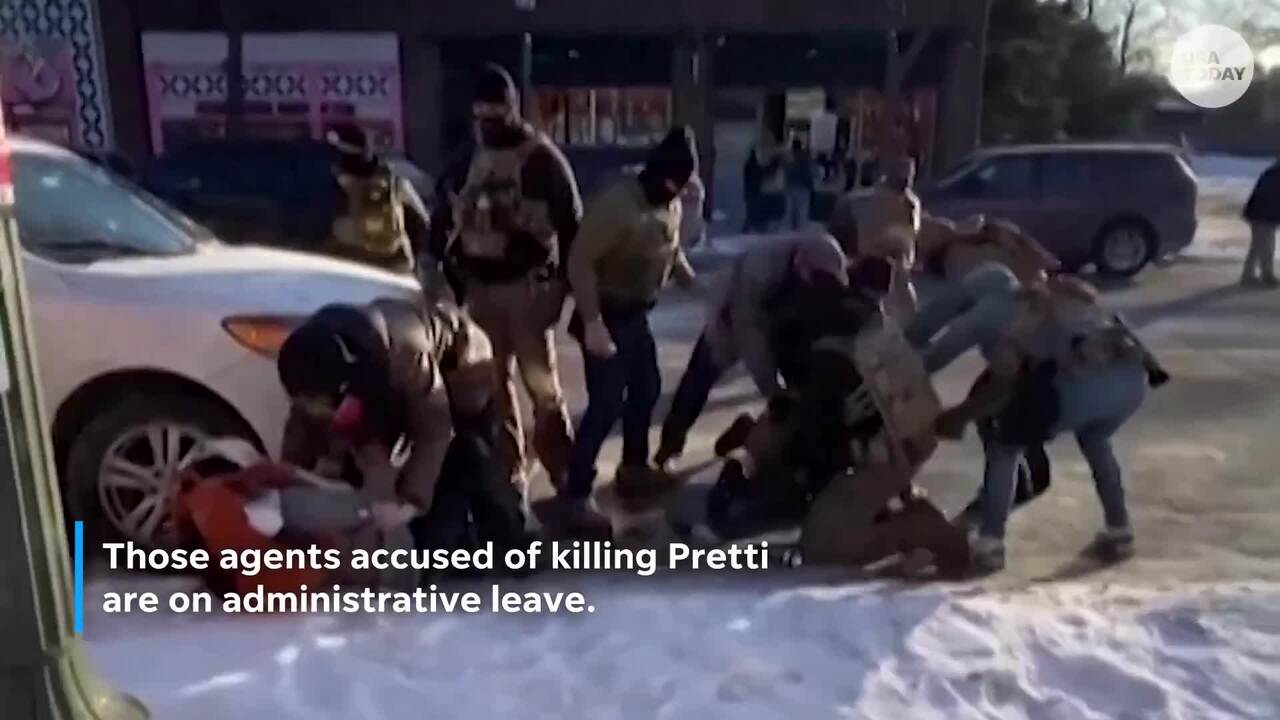
Videos show Pretti filming federal agents with his phone before he was taken to the ground, disarmed and shot in the back. The Department of Homeland Security said two agents opened fire, both of whom have beenplaced on leave.

Within hours of Pretti's death, the Minnesota Bureau of Criminal Apprehension and a local prosecutor's office went to court to gain access to the scene and even obtained a search warrant, a move state officials described in court records as unusual but necessary.

"In my 20-plus years at the BCA, prior to 2026, I had never encountered a situation in which federal authorities blocked BCA access to an incident where there is concurrent federal and state jurisdiction," Minnesota Bureau of Criminal Apprehension Superintendent Drew Evans said in a federal court filing.

U.S. District Judge Eric C. Tostrud issued a temporary restraining order barring federal authorities from "destroying or altering" evidence in the case. Tostrud later dissolved the order, writing there was no evidence to justify its extension.

TheU.S. Justice Department openeda civil rights investigation into the Pretti shooting, which could potentially lead to criminal charges against the officers involved, though there is a high legal bar to bring such a case. U.S. Customs and Border Protection opened a separate internal investigation into the incident.

(L/R) Rodney Scott, Commissioner of US Customs and Border Protection (CBP), Joseph Edlow, Director of US Citizenship and Immigration Services (USCIS), and Todd Lyons, acting director of US Immigration and Customs Enforcement (ICE), testify during a House Committee on Homeland Security hearing on Oversight of the Department of Homeland Security on Capitol Hill in Washington, DC, on Feb. 10, 2026. A staffer holds up a display of Renee Good and Alex Pretti who were both killed by ICE agents, during a House Homeland Security Committee hearing on Feb. 10, 2026 in Washington, DC. The Department of Homeland Security has faced criticism over law enforcement tactics targeting undocumented immigrants and the killing of two U.S. citizens in Minneapolis. Acting Director of U.S. Immigration and Customs Enforcement (ICE) Todd Lyons testifies during a House Homeland Security Committee hearing on Feb. 10, 2026 in Washington, DC. The Department of Homeland Security has faced criticism over law enforcement tactics targeting undocumented immigrants and the killing of two U.S. citizens in Minneapolis. Chairman U.S. Rep. Andrew Garbarino (R-NY) speaks during a House Homeland Security Committee hearing on Feb. 10, 2026 in Washington, DC. The Department of Homeland Security has faced criticism over law enforcement tactics targeting undocumented immigrants and the killing of two U.S. citizens in Minneapolis. Committee ranking member Representative Bennie Thompson, D-MS), speaks with a picture of Liam Ramos displayed behind him, a 5 year-old boy who was detained by ICE on January 20, during a House Committee on Homeland Security hearing on Oversight of the Department of Homeland Security on Capitol Hill in Washington, DC, on Feb. 10, 2026. Rodney Scott, Commissioner of US Customs and Border Protection (CBP), testifies during a House Committee on Homeland Security hearing on Oversight of the Department of Homeland Security on Capitol Hill in Washington, DC, on Feb. 10, 2026. (L/R) Rodney Scott, Commissioner of US Customs and Border Protection (CBP), Joseph Edlow, Director of US Citizenship and Immigration Services (USCIS), and Todd Lyons, acting director of US Immigration and Customs Enforcement (ICE), are sworn in during a House Committee on Homeland Security hearing on Oversight of the Department of Homeland Security on Capitol Hill in Washington, DC, on Feb, 10, 2026. Customs and Border Protection (CBP) Commissioner Rodney Scott and Citizenship and Immigration Services (USCIS) Director Joseph Edlow arrive for a House Homeland Security Committee hearing entitled

ICE, Border Patrol leaders face Congress over deadly Minnesota raids

The Justice Department previously declined to investigate the Good shooting, saying there's"no basis" for such an inquiry. That decision, as well as a push from top DOJ officials to instead investigate Good's wife, led to a wave of resignations at the U.S. attorney's office in Minnesota, according to multiple news outlets, includingThe New York TimesandNBC News.

ICE said that as part of an internal investigation, it is reviewing the conduct ofJonathan Ross, the agent who shot Good.

The Justice Department and ICE are also investigating whether the two officers involved in a shooting that injured Venezuelan immigrantJulio Cesar Sosa-Celislied under oath. Federal authorities launched the probe after video evidence appeared to contradict the officers' initial statements about the Jan. 14 shooting in Minneapolis.

Contributing: Reuters

Christopher Cann is a national breaking news reporter for USA TODAY. Contact him via email at ccann@usatoday.com.

This article originally appeared on USA TODAY:FBI won't share evidence related to Alex Pretti shooting, state says

FBI won't share evidence related to Alex Pretti shooting, state says

The FBI notified Minnesota state investigators that it will not share information or evidence related to the fatalshooti...


GL MAG © 2015 | Distributed By My Blogger Themes | Designed By Templateism.com